Trenchless sewer line replacement in Aurora
Replace or reline the whole sewer line through one or two small pits instead of a trench across the yard.
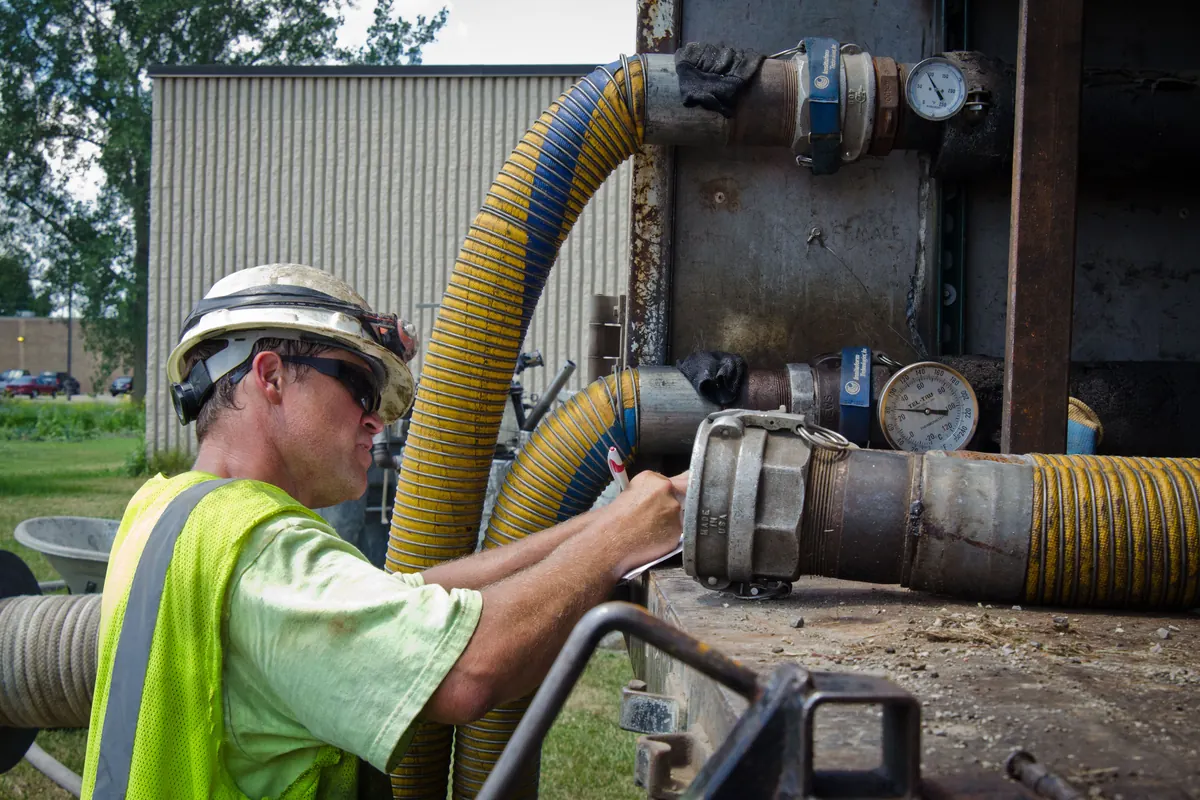
Compare the repair methods
See how much of the yard each method opens up, and which problems rule trenchless out.
What goes wrong
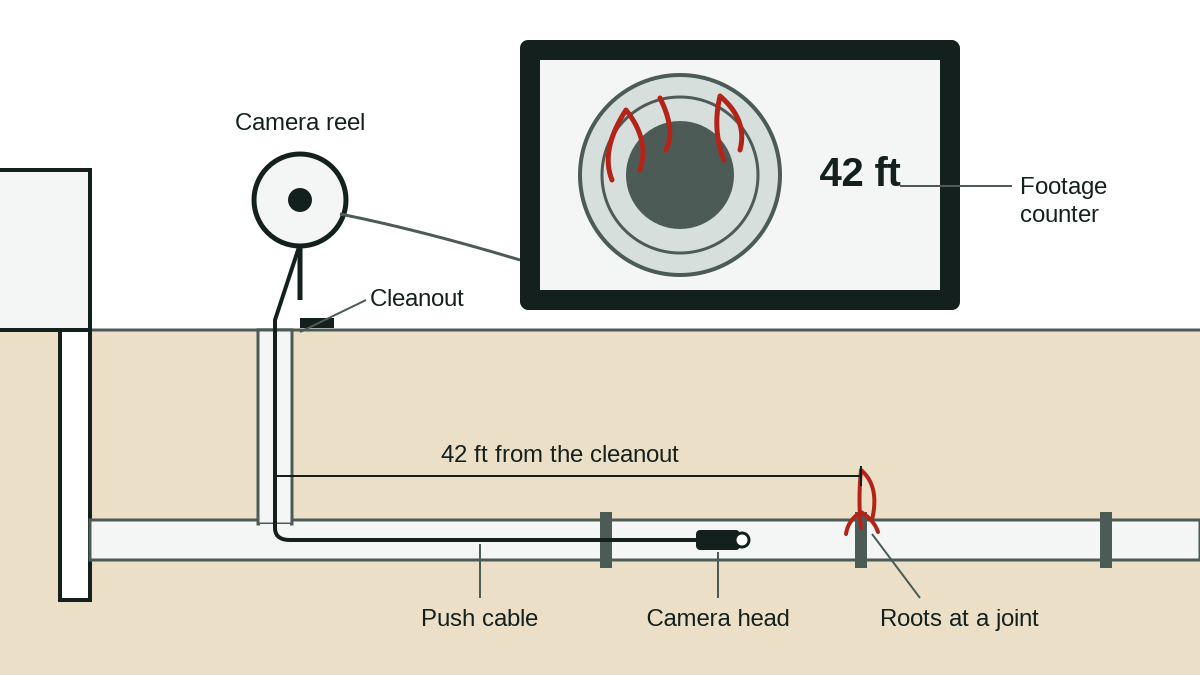
A camera inspection shows which of these you have and how far down the line it is. Ask for the video and a footage count to each problem.
Roots at a joint
Roots find the joints in old clay pipe, especially under mature cottonwoods, maples and elms. Cabling or hydro jetting cuts them back, but a line that clogs again within weeks usually has roots coming through a joint. Ask whether a liner or a repair at that joint beats repeated cleaning.
Belly (sag)
A low spot where the pipe has settled, so waste and water sit instead of draining. Shifting clay soil or poorly compacted backfill can cause it, and on camera it shows as standing water. Cabling never fixes it: the usual fix is digging up that section and re-bedding or replacing it. A deep belly can rule out trenchless.
Offset joint
One pipe section has shifted relative to the next, leaving a lip that catches debris. Expansive clay that swells when wet and shrinks when dry works on buried pipe for decades, which is why a line that tested fine ten years ago can have an offset joint today.
Crack or collapse
Cracks, holes, and pipe gone flat or egg-shaped. Orangeburg, a tar-paper pipe in some homes built from roughly 1945 to 1972, flattens with age, and cast iron can rust through on the bottom. One cracked section in a sound line can be a spot repair. Damage all along the line usually means replacement, and a fully collapsed pipe can rule out trenchless.
How it gets fixed
The hatched ground is what gets dug up. The camera footage should decide the method, not the sales pitch.
Spot repair: one pit
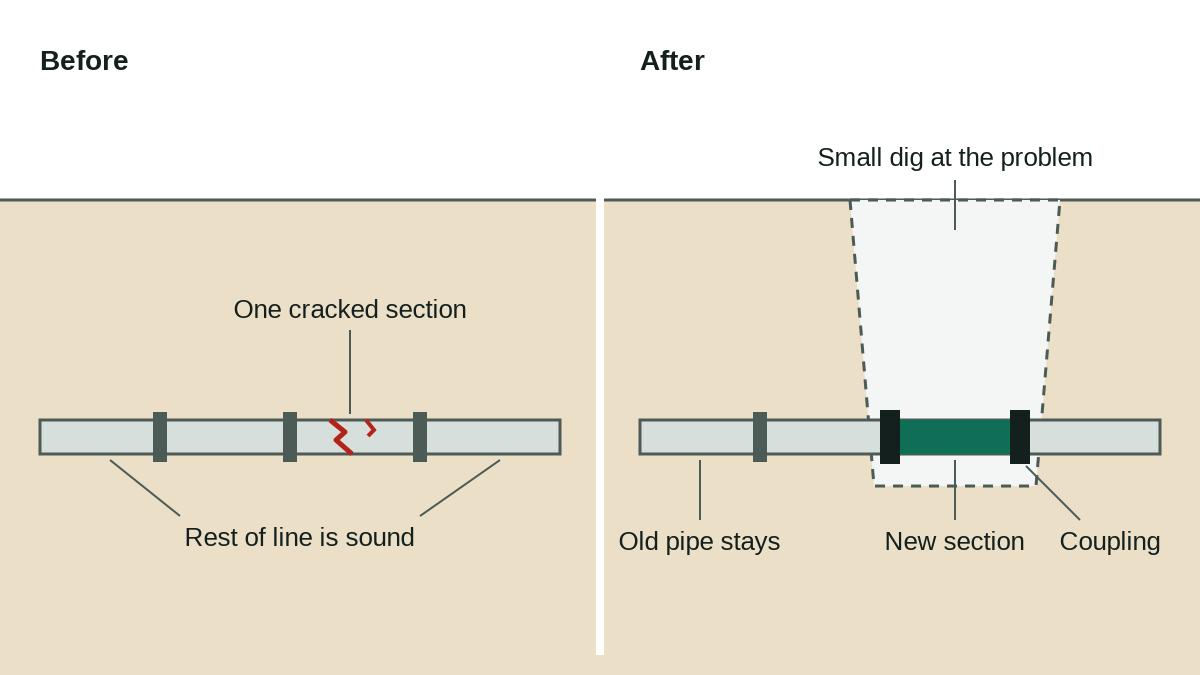
One pit over the bad section, which is cut out and replaced with a new piece joined to the old pipe. The right call when the camera shows one problem in an otherwise healthy line. If there is trouble every few feet, a repair just moves the next failure down the line.
Open trench: dig the whole line
The traditional replacement: a trench along the line, new pipe laid in, then backfilled. It is the fallback when trenchless will not work, such as a fully collapsed pipe, a deep belly or sharp bends. Plan on landscaping and concrete repair afterward.
Pipe bursting: two pits
A bursting head pulls a new pipe through the old one, breaking the old pipe outward as it goes. It needs an entry pit and an exit pit, so the yard, driveway and trees in between stay put.
Cured-in-place lining
A resin-soaked liner goes into the old pipe and hardens there, making a pipe within a pipe. It often needs only the cleanout or one small pit. It struggles when the old pipe has collapsed completely, has a deep belly, or changes direction sharply.
Schematic drawing, not to scale. General information, not an inspection of your line.
What it usually costs
- Trenchless replacement or lining, priced per foot: roughly $64 to $350 per foot depending on method and source
- Full trenchless replacement for a typical house: often $7,000 to $15,000
- Traditional open-trench replacement: about $110 to $250 per foot, plus landscaping and concrete repair afterward
Ranges are rough Denver-metro figures gathered from public cost guides and are only a starting point. Your contractor's written quote is the number that counts.
Two kinds of trenchless
- Pipe bursting pulls a new pipe through the old one, breaking the old pipe outward as it goes. It needs an entry pit and an exit pit.
- Cured-in-place lining (CIPP) inserts a resin-soaked liner that hardens inside the old pipe, making a pipe within a pipe. It often needs only the cleanout or one small pit.
When trenchless fits, and when it does not
Trenchless shines when the line runs under a driveway, mature trees or landscaping you want to keep. It struggles when the old pipe has collapsed completely, has a deep belly, or changes direction sharply. A camera inspection decides this, not the sales pitch.
Questions to ask
- Which method are you quoting and why that one for my line?
- How many pits, where, and what will the yard look like after?
- Does the price include reinstating the connection at the city main and the cleanout?
- What size and type of pipe or liner goes in, and what is the warranty?
- Will you send a camera video of the finished line?
Where this service is available
Aurora, North and Original Aurora, Southeast Aurora, Centennial, Englewood, Park Hill (Denver), Lowry and Montclair (Denver).
Get a free quote
Takes about a minute. Questions? Email [email protected].
Related services
Sewer line repair
Fix one bad section of pipe instead of replacing the whole line, when the rest of it is still sound.
Sewer camera inspection
A camera run down the line to find roots, cracks, sags and old pipe before anyone digs. Smart before buying an older home.
Hydro jetting and main line cleaning
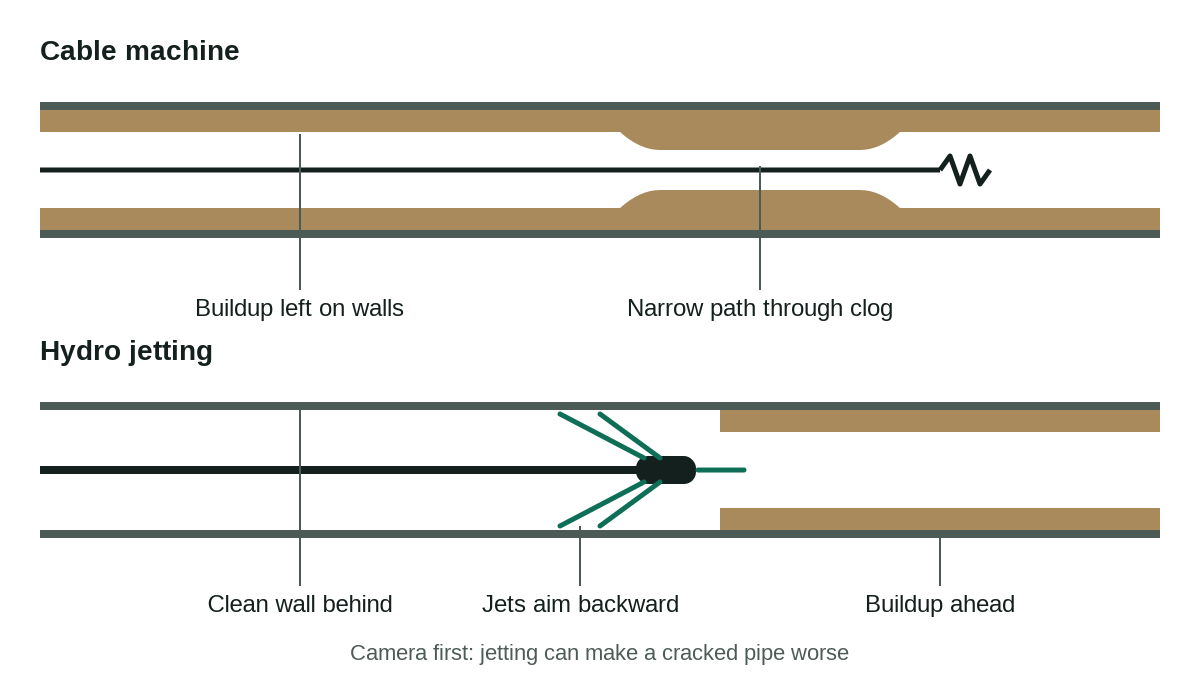
Clear roots, grease and buildup from the main line with a cable machine or high-pressure water.
Emergency sewer backup
Sewage coming up a floor drain or tub. What to do first, and getting a contractor out fast.