Sewer line repair in Aurora, without the runaround
Drains gurgling, a basement floor drain backing up, or an inspection report that says your line is cracked? Call or send one short form and a local sewer contractor gets back to you, usually the same day.
Explore your sewer line
Pick a part of the line, a common problem, or a repair method. Tapping the drawing works too.
Parts of the line
In Aurora the homeowner owns and repairs the whole sewer service line, from the house to the city main, including damage it causes.
House drain
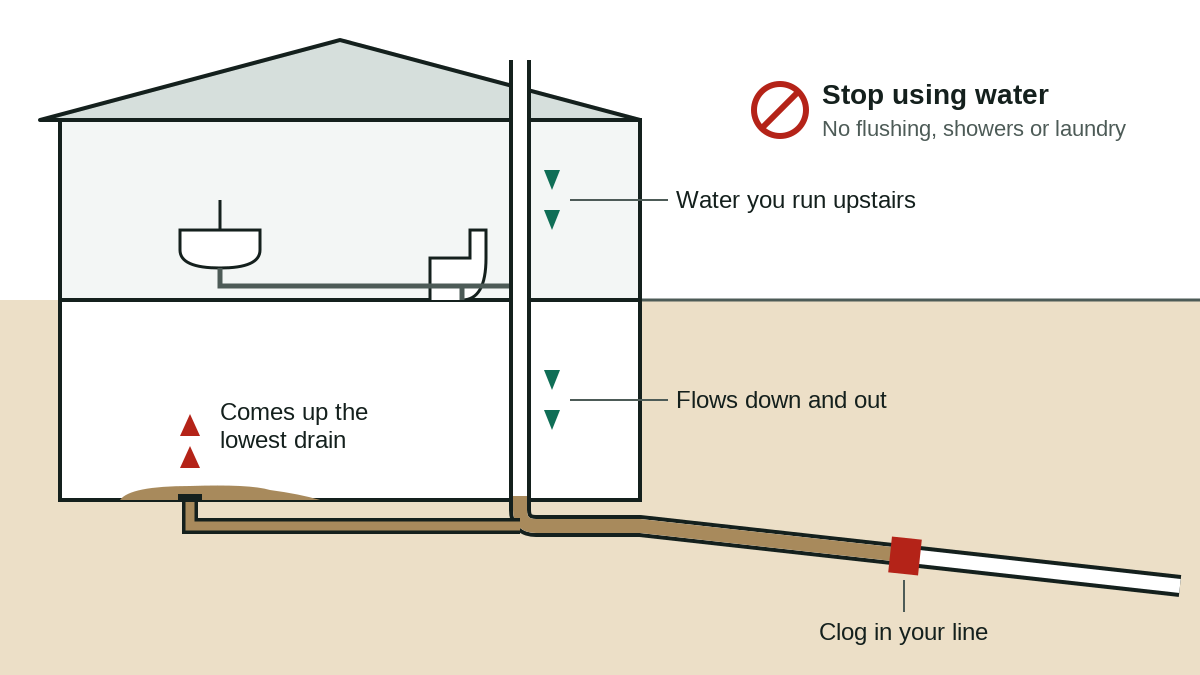
The pipe that collects every drain in the house and carries it out through the foundation. When the line is blocked, water you run anywhere in the house comes out at the lowest drain, often the basement floor drain.
- More than one drain backing up at once
- Gurgling toilets when the washer drains
- Sewage smell in the basement
Cleanout
A capped pipe that gives a contractor a straight way into the line without pulling a toilet. Camera inspections and cleaning usually start here, and a cured-in-place liner often goes in through it. Worth finding yours before you need it.
Under the yard
The longest stretch, and where most trouble shows up: roots at the joints of old clay pipe, cracks and low spots from shifting clay soil, and aging pipe. The age of the house predicts a lot:
- Built before about 1975: clay, cast iron or occasionally Orangeburg
- 1975 to 1995: often ABS or early PVC
- After 1995: PVC
A soggy or unusually green strip of lawn between the house and the street is a classic sign.
Under the sidewalk and street
In Aurora this is still the homeowner's line, all the way to the city main. Digging under a driveway or sidewalk is one of the things that moves the price, and it is where trenchless methods earn their keep.
In Denver, work in the public right-of-way (between the sidewalk and the street) can need extra permits and traffic control.
Tap at the city main
Where your line joins the public sewer main. The city or sanitation district handles the main itself. If neighbors are backing up too, the main may be blocked: call Aurora Water's after-hours line before paying a contractor.
When a line is replaced, ask whether the price includes reinstating the connection at the main.
What goes wrong
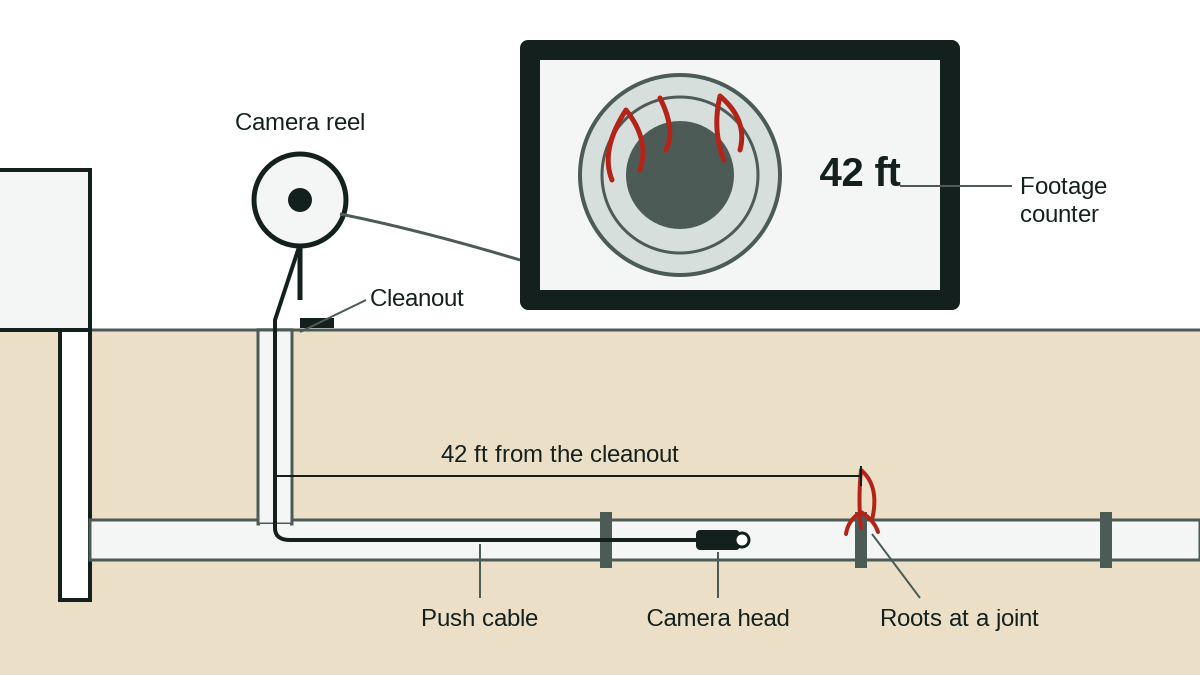
A camera inspection shows which of these you have and how far down the line it is. Ask for the video and a footage count to each problem.
Roots at a joint
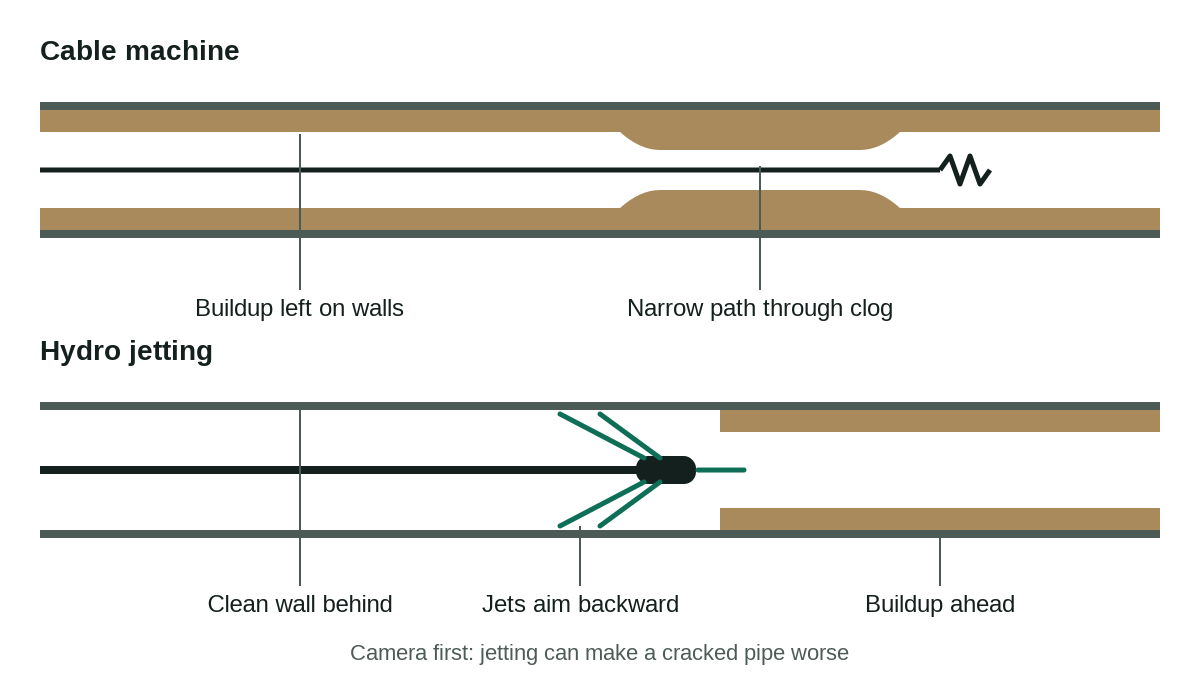
Roots find the joints in old clay pipe, especially under mature cottonwoods, maples and elms. Cabling or hydro jetting cuts them back, but a line that clogs again within weeks usually has roots coming through a joint. Ask whether a liner or a repair at that joint beats repeated cleaning.
Belly (sag)
A low spot where the pipe has settled, so waste and water sit instead of draining. Shifting clay soil or poorly compacted backfill can cause it, and on camera it shows as standing water. Cabling never fixes it: the usual fix is digging up that section and re-bedding or replacing it. A deep belly can rule out trenchless.
Offset joint
One pipe section has shifted relative to the next, leaving a lip that catches debris. Expansive clay that swells when wet and shrinks when dry works on buried pipe for decades, which is why a line that tested fine ten years ago can have an offset joint today.
Crack or collapse
Cracks, holes, and pipe gone flat or egg-shaped. Orangeburg, a tar-paper pipe in some homes built from roughly 1945 to 1972, flattens with age, and cast iron can rust through on the bottom. One cracked section in a sound line can be a spot repair. Damage all along the line usually means replacement, and a fully collapsed pipe can rule out trenchless.
How it gets fixed
The hatched ground is what gets dug up. The camera footage should decide the method, not the sales pitch.
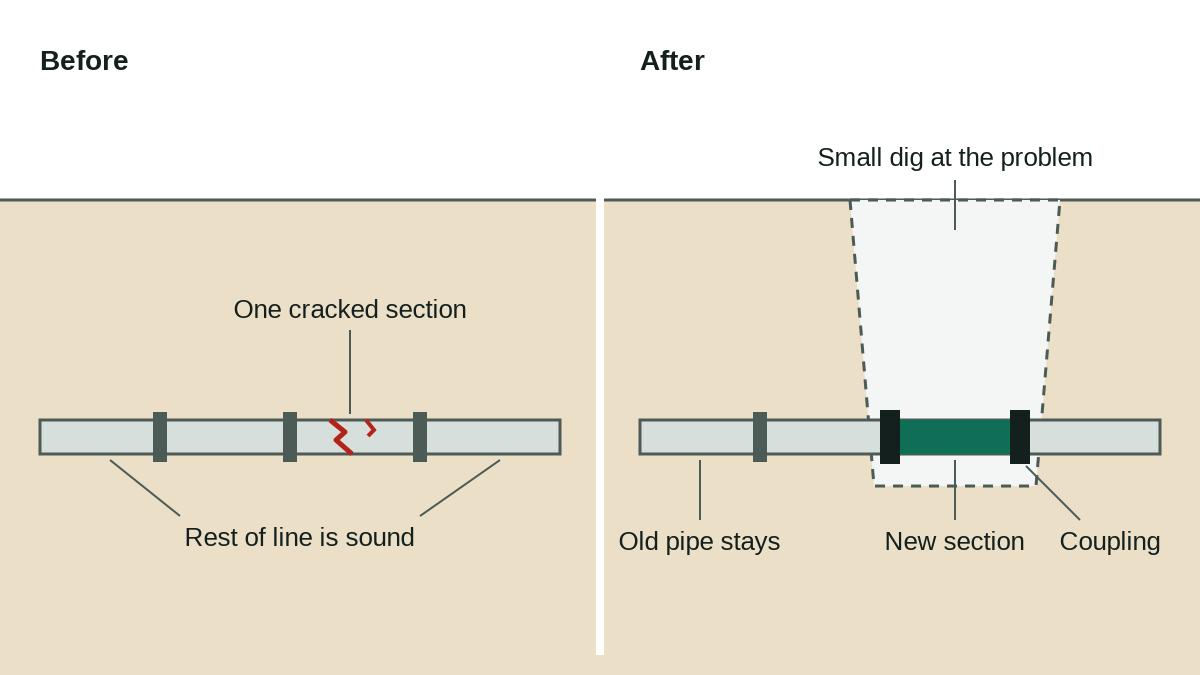
Spot repair: one pit
One pit over the bad section, which is cut out and replaced with a new piece joined to the old pipe. The right call when the camera shows one problem in an otherwise healthy line. If there is trouble every few feet, a repair just moves the next failure down the line.
Open trench: dig the whole line
The traditional replacement: a trench along the line, new pipe laid in, then backfilled. It is the fallback when trenchless will not work, such as a fully collapsed pipe, a deep belly or sharp bends. Plan on landscaping and concrete repair afterward.
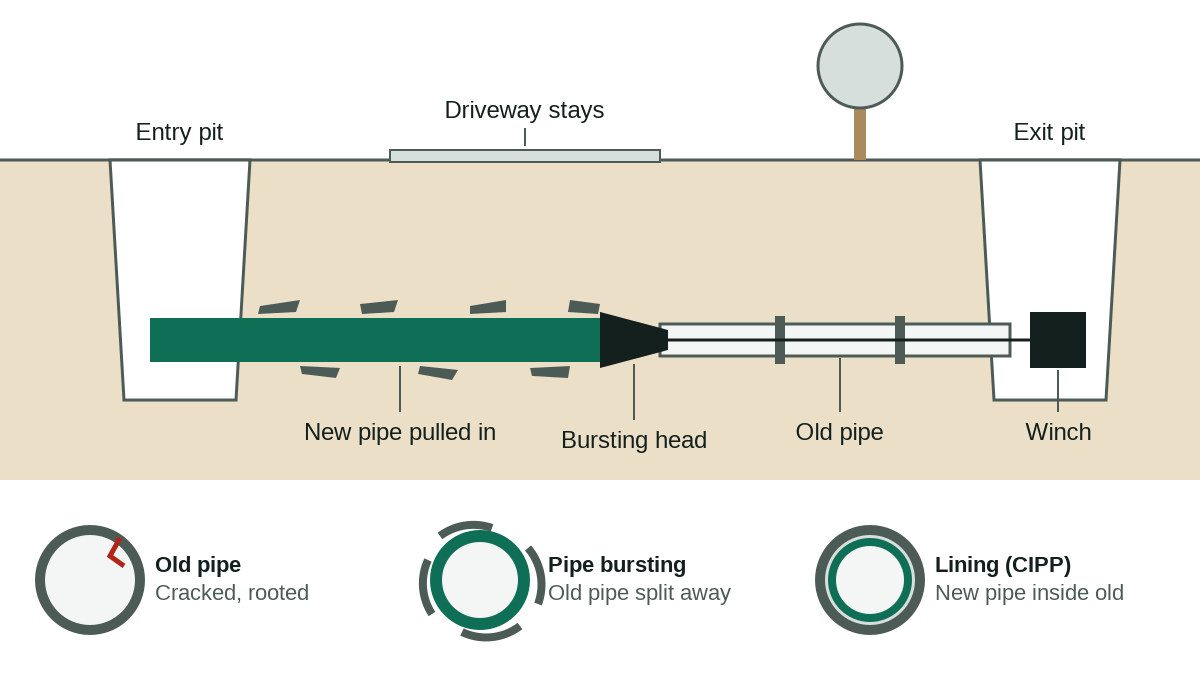
Pipe bursting: two pits
A bursting head pulls a new pipe through the old one, breaking the old pipe outward as it goes. It needs an entry pit and an exit pit, so the yard, driveway and trees in between stay put.
Cured-in-place lining
A resin-soaked liner goes into the old pipe and hardens there, making a pipe within a pipe. It often needs only the cleanout or one small pit. It struggles when the old pipe has collapsed completely, has a deep belly, or changes direction sharply.
Schematic drawing, not to scale. General information, not an inspection of your line.
Sewer work we can connect you with
Sewer line repair
Fix one bad section of pipe instead of replacing the whole line, when the rest of it is still sound.
Trenchless sewer replacement
Replace or reline the whole sewer line through one or two small pits instead of a trench across the yard.
Sewer camera inspection
A camera run down the line to find roots, cracks, sags and old pipe before anyone digs. Smart before buying an older home.
Hydro jetting and main line cleaning
Clear roots, grease and buildup from the main line with a cable machine or high-pressure water.
Emergency sewer backup
Sewage coming up a floor drain or tub. What to do first, and getting a contractor out fast.
Your sewer line is your problem, not the city's
In Aurora the homeowner owns the sewer service line all the way from the house to the city main, and that includes the damage when it fails. Most standard homeowners policies leave the line out too, unless you added a service line endorsement. That is why it pays to understand what is wrong before anyone starts digging.
The usual suspects on the Front Range
- Tree roots. Roots find the joints in old clay pipe, especially under mature cottonwoods, maples and elms in the older parts of town.
- Old pipe materials. Homes built before the 1970s often have clay or cast iron lines, and some from roughly 1945 to 1972 have Orangeburg, a tar-paper pipe that flattens with age.
- Shifting clay soil. Expansive clay swells when wet and shrinks when dry. Over decades that can crack joints or leave a low spot (a belly) where waste settles.
- Grease and wipes. Even a healthy line clogs if it gets grease, wipes and paper towels.
Start with a camera, not a shovel
A sewer camera inspection shows the actual problem and how far down the line it is. With that video you can compare quotes on the same facts. Ask for a copy of the footage either way.
How it works
- Call or send the short form. Tell us what is going on and where.
- We pass your request to one independent local contractor who handles this kind of work in your area. Not a list of five companies, one.
- The contractor contacts you, looks at the job and gives you a price. You decide. Using this service costs you nothing.
Areas covered
- Aurora
Colorado's third-largest city, with housing from the 1940s to last year. The age of your house predicts a lot about your sewer line.
- North and Original Aurora
The oldest housing in the city, much of it postwar. Clay pipe, root intrusion and the odd Orangeburg line are common.
- Southeast Aurora
Mostly newer construction with PVC lines. Failures are rarer and usually about settling, damage or clogs, not old pipe.
- Centennial
Lots of 1970s and 1980s neighborhoods, so lines are getting to the age where joints and early plastic pipe start to fail.
- Englewood
Small postwar homes on mature, tree-lined blocks. Original clay lines and root intrusion are the story here.
- Park Hill (Denver)
Early-1900s to 1950s homes and very large trees. Root-damaged clay lines are the most common call.
- Lowry and Montclair (Denver)
Two neighbors with very different houses: older Montclair homes on clay lines, and Lowry's newer construction on PVC.
Common questions
Who is responsible for the sewer line, me or the city?
In Aurora, the homeowner is responsible for the sewer service line from the house to the city main, including damage it causes. Denver works the same way for the service line. The city or sanitation district handles the main itself.
Does homeowners insurance cover a broken sewer line?
Usually not, unless you added a service line or sewer backup endorsement. Check your policy, and take photos of any damage before cleanup.
How do I know whether to repair or replace?
Get a camera inspection. One problem in a sound line usually means a repair. Problems spread along the line, old Orangeburg pipe, or a line that keeps failing usually means replacement is cheaper over time.
How much does sewer line replacement cost in Aurora?
Full replacement often runs $7,000 to $15,000, with traditional digging at about $110 to $250 per foot and trenchless methods quoted per foot as well. Depth, length, and what sits on top of the line move the price the most.
Get a free quote
Takes about a minute. Questions? Email [email protected].